El Placer Farms – Sebastián Ramiréz
CountryColombia
RegionEl Eje Cafetero, Quindio
FarmEl Placer
Altitude1 500 – 1 744 m.n.m.
Size of the farm1000 ha
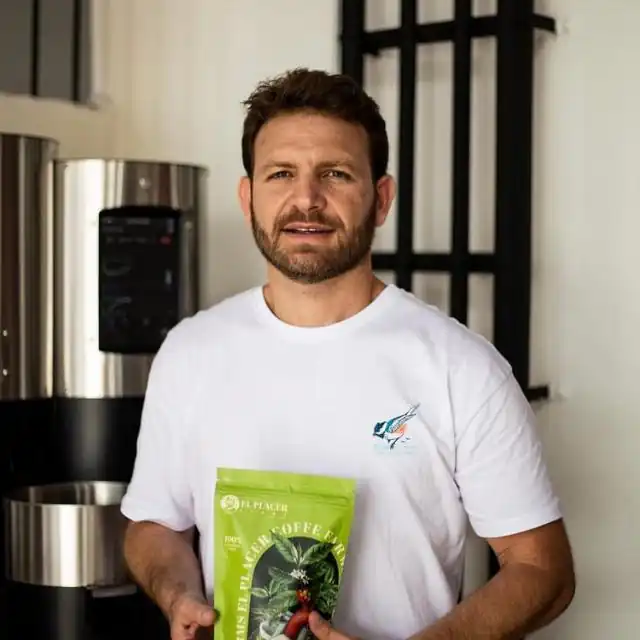
My name is Sebastián Ramírez and I am the founder of the El Placer Farms project. Initially, I worked with coffee from my own farm and my father’s, but over time I began including coffee from other family members’ farms as well. My goal was to establish a direct connection between us — the coffee producers — and you, the roasters, by eliminating intermediaries and offering coffees with a truly unique character. Thanks to the support of my family and other key collaborators, the El Placer Farms project was born. Today, it encompasses several farms.
Sustainability is our top priority. On our farms, we use innovative irrigation systems and focus on natural, environmentally friendly coffee processing methods that minimise our environmental impact. Looking ahead, we plan to further reduce our ecological footprint and continue to promote sustainable agricultural practices. Beyond coffee, we are committed to community initiatives, such as rescuing abandoned animals through our Bienestar Animal foundation. This initiative has already helped many dogs find new homes. At El Placer Farms, our goal is to produce exceptional coffee and make a positive impact on the world around us.
Team members
Our project is founded on the principles of collaboration, transparency, and sustainability. The farms involved share a common vision – to produce high-quality coffee with respect for both nature and the people behind it. Among the key partners I collaborate with are Wilder Lazo, Heiner Lasso, and Don Segundo Lazo. Their experience and dedication help us not only produce exceptional coffee but also inspire other farmers who wish to begin their own journey.
Sebastián Ramiréz
Sebastián Ramírez is the founder of the El Placer Farms project (see information above).
Wilder Lazo
Wilder Lazo is a Colombian farmer and specialty coffee producer who owns the Bella Alejandría farm in San Adolfo, Huila. Situated at an elevation of 1,890–2,100 meters above sea level, the farm offers ideal conditions for growing exceptional coffee. Wilder focuses on innovations in coffee genetics and advanced processing techniques, always striving to achieve the highest quality and uniqueness in every lot.
At Bella Alejandría, Wilder cultivates a range of premium varieties such as Gesha (Geisha), Pink Bourbon, SL28, and Wush Wush. For processing, he employs modern methods, including anaerobic fermentation and other experimental techniques, which give his coffees complex flavor profiles with floral, fruity, and citrus notes. Thanks to his meticulous approach and passion for quality, his coffees have earned international recognition and often appear in prestigious competitions such as the Brewers Cup. Wilder is rightfully regarded as one of the pioneers of a new generation of Colombian farmers who are pushing the boundaries of specialty coffee.
Heiner Lasso
Heiner Lasso is a talented farmer from San Adolfo in the Huila region of Colombia, specializing in the production of specialty coffee. Together with his brother, Wilder Lazo, he continues the family tradition of coffee cultivation, renowned for its quality and uniqueness. While Wilder’s coffees have already gained recognition among coffee enthusiasts, Heiner’s offerings remain a hidden gem waiting to be discovered.
His farm, El Rubí, is a place where traditional practices meet innovative coffee-processing methods. Heiner focuses on precise fermentation and processing techniques that bring exceptional flavor complexity to his coffees. His approach is rooted in meticulous care, respect for nature, and a desire to bring coffees to the market that stand out for their quality and distinctive character.
Heiner’s work is proof that specialty coffee is not only about the product itself but also about the people behind it. His dedication, passion, and attention to detail make him an inspiring figure in the coffee industry.
Segundo Lasso
Mr. Segundo Lasso is an experienced farmer who, together with his son Wilder, has been cultivating coffee for more than twenty years. His name is associated with exceptional quality and a long-standing tradition in the production of specialty coffee. Mr. Segundo is known for his meticulousness and attention to detail, which are reflected in every cup of his coffee. His work is a symbol of dedication and craftsmanship that has earned recognition worldwide.
About the coffee
Co-Fermented Coffees
At El Placer, we are passionate about pushing the boundaries of coffee innovation. Our co-fermented coffees are a testament to our commitment to creativity and quality. But what exactly is co-fermentation? Let us explain!
Co-Fermentation at El Placer involves adding non-coffee products during fermentation, which introduces new flavor compounds, creating complex and distinctive taste profiles that are difficult to achieve through traditional methods. This innovative method allows us to create unique and exciting flavor profiles. For us, it’s not just about experimenting; it’s about opening doors to new coffee experiences and welcoming a new generation of coffee enthusiasts.
By co-fermenting, we aim to introduce specialty coffee to those who might find traditional high-end coffee challenging, sparking curiosity and making everyone feel welcome.
Transparency is key. We proudly share our co-fermentation methods with our customers. Our co-fermented coffees have gained recognition in the industry, including our Caturra Purple Fruits coffee, roasted by Cromatic Coffee in the United States, which scored 93 points by the Coffee Review team, and our Caturra Yellow Fruits co-fermented coffee, roasted by Dark Woods Coffee in the United Kingdom, nominated for the prestigious Golden Forks awards.
By being open about our process, we ensure that our customers know exactly what they are enjoying. Our co-fermented coffees are crafted with love, passion, and a relentless pursuit of excellence. Join us on this exciting journey and discover the innovative flavors of our co-fermented coffees.
Mossto
Immerse yourself in the intriguing universe of mossto at El Placer Farms, where the key to our success lies in the magic of fermentation! From obtaining a unique leachate to applying the perfect activator, mossto makes each cup at El Placer Farms a distinctive sensory experience.
The secret to our mossto: 10% of the total weight of cherries, no additives or water. We control pH and temperature for optimal quality.
Mossto: the perfect activator. Accelerates fermentations, adds fruity notes, and complexity. Discover how we achieve coffees with body, acidity, and unique flavors at El Placer Farms.
Compared to carbonic maceration, our mossto generates its own CO2 and minimizes oxygen. Controls temperature without the need for special facilities.
Key recommendations: microbiological analysis, systematic testing, and combination with slow drying for exceptional coffees.
Innovate in your coffee plantation! Explore the possibilities of mossto at El Placer Farms, where each cup is a unique experience in the world of computational coffee.
Yellow fruits
Yellow fruits is processed by co-fermentation with passion fruit and mango.
95% of cherries are hand-picked ripe, and 5% are semi-ripe. Anaerobic fermentation takes place in 200-liter tanks for 120 hours at a constant temperature of 18 °C, with wine yeast. The next step is depulping the coffee, followed by carbonic maceration for 72 hours, during which carbon dioxide is injected. At this stage, dehydrated passion fruit, mango, and fruit glucose are added to the tanks.
The coffee is then monitored during drying at 40 °C in a dryer. The drying phase lasts approximately 5 days. All drying is slow and carefully controlled. The final stage is packing into bags and stabilizing the coffee, which takes approximately 15 days.
Purple fruits
Purple fruits is processed by co-fermentation with red grape wine.
95% of cherries are hand-picked ripe, and 5% are semi-ripe. Anaerobic fermentation takes place in 200-liter tanks for 120 hours at a constant temperature of 18 °C, with wine yeast. The next step is depulping the coffee, followed by carbonic maceration for 72 hours, during which carbon dioxide is injected. At this stage, dehydrated red grape wine fruit and fruit glucose are added to the tanks.
The coffee is then monitored during drying at 40 °C in a dryer. The drying phase lasts approximately 5 days. All drying is slow and carefully controlled. The final stage is packing into bags and stabilizing the coffee, which takes approximately 15 days.
Red fruits
Red fruits is processed by co-fermentation with strawberries and cranberries.
95% of cherries are hand-picked ripe, and 5% are semi-ripe. Anaerobic fermentation takes place in 200-liter tanks for 120 hours at a constant temperature of 18 °C, with wine yeast. The next step is depulping the coffee, followed by carbonic maceration for 72 hours, during which carbon dioxide is injected. At this stage, dehydrated strawberries, cranberries, and fruit glucose are added to the tanks.
The coffee is then monitored during drying at 40 °C in a dryer. The drying phase lasts approximately 5 days. All drying is slow and carefully controlled. The final stage is packing into bags and stabilizing the coffee, which takes approximately 15 days.
Orange fruits
Orange fruits is processed by co-fermentation with orange fruits especially peaches.
95% of ripe and 5% of semi-ripe cherries are hand-picked. This is followed by anaerobic fermentation in 200 litre tanks for 120 hours at a constant temperature of 18 °C with CO2 injection and the addition of wine yeast. The next step is the cleaning of the coffee from the skin, followed by anaerobic fermentation for 72 hours with CO2 injection and the addition of dehydrated peaches with glucose, when we monitor the PH in the tank. During drying, the coffee is checked and dried at 40 °C and 25 % humidity for approximately 15 days. This is followed by a second drying phase, which takes place in the shade under the canopy of the trees for approximately 5 days. Both drying phases are slow and controlled. This is followed by the stabilisation of the beans, when the coffee is stored in GrainPro bags for 15 days to stabilise its flavours.
Lychee
Lychee is processed by co-fermentation with lychee.
95% of cherries are hand-picked ripe, and 5% are semi-ripe. Anaerobic fermentation takes place in 200-liter tanks for 120 hours at a constant temperature of 18 °C with CO2 injection. Carbon dioxide is injected to remove all air, allowing controlled fermentation without temperature increase in the tanks. During this fermentation stage, pulp inoculated with lactic acid is added. Microorganisms are isolated from lemongrass. The first drying phase is monitored at 40 °C with 25% humidity for approximately 20 days. The second drying phase takes place in the shade in the tree canopy for approximately 5 days. All drying phases are slow and carefully controlled. The final stage is grain stabilization, with the coffee stored in GrainPro bags for 15 days to balance the flavors.
IPA
IPA is processed using the honey method.
95% of cherries are hand-picked ripe, and 5% are semi-ripe. Anaerobic fermentation takes place in 200-liter tanks for 120 hours at a constant temperature of 18 °C with CO2 injection. Carbon dioxide is injected to remove all air, allowing controlled fermentation without temperature increase in the tanks. During this fermentation stage, pulp inoculated with lactic acid is added. The coffee is then depulped and added to tanks along with pulp and microorganisms and hops, where it ferments for another 100 hours with carbonic maceration. The first drying phase is monitored at 40 °C with 25% humidity for approximately 20 days. The second drying phase takes place in the shade under tree canopies for approximately 5 days. All drying phases are slow and carefully controlled. The final stage is grain stabilization, where the coffee is stored in GrainPro bags for 15 days to balance the flavors.
Cinnamon
Cinnamon is processed by co-fermentation with cinnamon.
95% of cherries are hand-picked ripe, and 5% are semi-ripe. Anaerobic fermentation takes place in 200-liter tanks for 120 hours at a constant temperature of 18 °C with CO2 injection. The coffee is then ground and ferments for another 120 hours in dry fermentation with cinnamon chips. The first drying phase is monitored at 40 °C with 25% humidity for approximately 15 days. The second drying phase takes place in the shade under tree canopies for approximately 5 days. Both drying phases are slow and carefully controlled.
Wush wush – Wilder Lazo
The Wush Wush variety is processed naturally.
95% of cherries are hand-picked ripe, and 5% are semi-ripe. Anaerobic fermentation takes place in 200-liter tanks for 280 hours at a constant temperature of 18 °C with CO2 injection and “mostto” (inoculated pulp). The first drying phase is monitored at 40 °C with 25% humidity for approximately 15 days. The second drying phase takes place in the shade under tree canopies for approximately 5 days. Both drying phases are slow and carefully controlled. The final stage is grain stabilization, where the coffee is stored in GrainPro bags for 15 days to balance the flavors.
Decaf
Decaf is processed using the washed method and begins with cherry harvest and sorting, focusing on quality with 90% ripe cherries and 10% semi-ripe cherries. Cherries are crushed on the same day as harvesting to ensure maximum freshness. Coffee is then fermented in traditional tanks for 24 to 36 hours and washed three times to remove all remaining impurities.
The drying phase takes place on tarps for 15 days with slow and controlled drying. The coffee is packed in GrainPro bags and left to stabilize for 15 days. Finally, the coffee is depulped and electronically sorted to ensure that only the best beans reach your cup. Decaffeination (sugarcane method) is carried out at a facility in Manizales.
Pink fruits
Harvesting and sorting: protocol requires at least 95% ripe cherries and 5% semi-ripe cherries, with all cherries having 18–20 degrees Brix.
Anaerobic fermentation: coffee ferments in 200-liter barrels for 120 hours at a constant temperature of 18 °C. Wine yeast is added. Then cherries are depulped.
Secondary 72-hour anaerobic fermentation with CO2 injection and addition of dehydrated fruit. In this lot, melon and fruit glucose are added. pH is monitored.
Drying: beans are moved to dryers and dried at 40 °C for approximately 5 days. All drying is slow and carefully controlled.
Stabilization: dried coffee is packed in GrainPro bags and rested for 15 days.
Thermal Shock
Thermal Shock is processed using a thermal shock method.
95% of cherries are hand-picked ripe, and 5% are semi-ripe. Anaerobic fermentation takes place in 200-liter tanks for 120 hours at a constant temperature of 18 °C with controlled CO2 injection to create an oxygen-free environment that enhances flavor. After depulping, the coffee undergoes a second fermentation phase for 120 hours. During this phase, the beans are submerged in water and subjected to a thermal shock at 40 °C. The water is enriched with forest berries, which helps lock in the unique berry flavors and gives the coffee a complex profile.
The first drying phase takes place under a canopy at a maximum temperature of 40 °C and 25% humidity for approximately 20 days. The second drying phase occurs in a parabolic dryer for approximately 5 days, with shading to prevent over-drying and ensure even moisture. Both drying phases are slow and carefully controlled.
The coffee is then packed in GrainPro bags and left to stabilize for 15 days, allowing the beans to reach a balanced state and enhancing flavor consistency.
Finally, the coffee is depulped to remove the parchment layer and hand-sorted to ensure only the highest quality beans are selected.
Pink Bourbon W
Pink Bourbon Washed is processed using the washed method.
90% of cherries are hand-picked ripe, and 10% are semi-ripe. The coffee is depulped on the same day as harvesting. Fermentation takes place in traditional tanks for 24 to 36 hours, after which the coffee is washed three times.
The drying phase takes place under a shelter for approximately 15 days. All drying is slow and carefully controlled.
After drying, the coffee is packed in GrainPro bags and left to stabilize for 15 days to balance the flavors.
Finally, the coffee is depulped and electronically sorted to ensure the highest quality beans.
Pink Bourbon N
Pink Bourbon Natural is processed naturally.
95% of cherries are hand-picked ripe, and 5% are semi-ripe. Anaerobic fermentation takes place in 200-liter tanks for 200 hours at a constant temperature of 18 °C with CO2 injection.
The first drying phase takes place under a shelter at 40 °C with 25% humidity for approximately 20 days. The second drying phase takes place in the shade for approximately 5 days. All drying is slow and carefully controlled.
After drying, the coffee is packed in GrainPro bags and left to stabilize for 15 days to balance the flavors.
Finally, the coffee is depulped, hand-sorted, and packed in vacuum bags.
Caturra Red N
Caturra Red Natural is processed naturally.
95% of cherries are hand-picked ripe, and 5% are semi-ripe. Anaerobic fermentation takes place in 200-liter tanks for 72 hours.
The first drying phase takes place under a shelter at 40 °C with 25% humidity for approximately 15 days. All drying is slow and carefully controlled.
After drying, the coffee is packed in GrainPro bags and left to stabilize for 15 days to balance the flavors.
Finally, the coffee is depulped and hand-sorted to ensure the highest quality beans.
Geisha White H
Gesha White Honey is processed using the honey method.
95% of cherries are hand-picked ripe, and 5% are semi-ripe. Anaerobic fermentation takes place in 200-liter tanks for 48 hours at a constant temperature of 18 °C with CO2 injection. Afterwards, the beans are submerged in water with oxygen pumping for 48 hours.
The first drying phase takes place under a shelter at 40 °C with 25% humidity for approximately 20 days. The second drying phase occurs in a parabolic dryer for approximately 5 days. All drying is slow, carefully controlled, and shaded.
After drying, the coffee is packed in GrainPro bags and left to stabilize for 15 days to balance the flavors.
Mango fruits H
Mango Fruit Honey is processed using the honey method.
95% of cherries are hand-picked ripe, and 5% are semi-ripe. The cherries have a Brix value of 18–20. Anaerobic fermentation takes place in 200-liter tanks for 120 hours at a constant temperature of 18 °C with wine yeast. The coffee is then depulped and undergoes a second anaerobic fermentation for 72 hours with CO2 injection. Dehydrated mango and fruit glucose are added to the tanks, and the pH is monitored.
The first drying phase takes place under a shelter at 40 °C. The second drying phase also occurs under a shelter in the shade for approximately 5 days. All drying is slow and carefully controlled.
After drying, the coffee is packed in GrainPro bags and left to stabilize for 15 days to balance the flavors.
Geisha natural
Variety: Geisha
Process: mosto fermentation natural
The beans are placed in sealed bags for 80 hours in the cherries. During this time, the coffee cherries soften and the pulp gradually collects at the bottom of the bag. After 80 hours, the beans are transferred to tanks and immersed in this pulp again.
The beans are sealed in tanks without CO2 for 120 hours. The pH value is regulated so that it does not fall below 5.5, and the temperature is maintained between 12–14 °C.
The coffee is then simply dried in dryers.